

Christmas
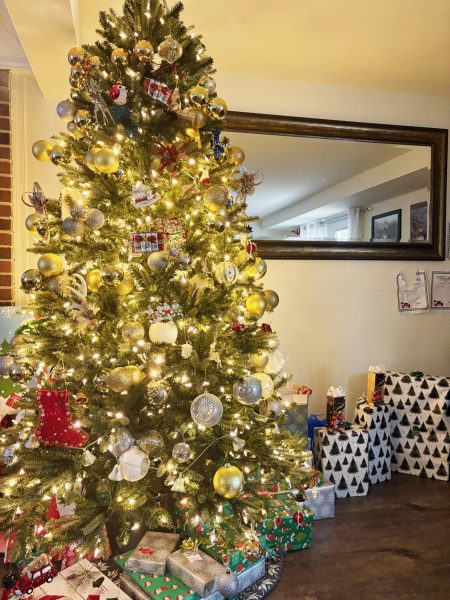
Christmas is the most popular holiday celebrated here in the United States but also around the entire world by roughly 2 billion people from Dec. 24th to Dec. 25th. The Christian holiday is centered around the birth of Jesus Christ.
Christmas, though based in Christianity, has expanded to be a modern and fantastical celebration enjoyed by non-Christians as well. It provides a time for individuals to spend with their families.
One big icon of Christmas is the Christmas tree which is usually a fir, spruce, or pine tree. The tree first appeared in Strasbourg, Germany all the way back in 1605 however the typical lights you see on trees were first recorded starting as real burning candles in 1611. Although the trees are traditionally associated with being a Christian icon, their modern use is largely non religious or don’t have as much connection to christianity as compared to older trees. Another big Christmas tradition is following an advent calendar.
Most calendars contain small sweets however can be anything depending on the type of calendar you get. According to tradition the calendars first showed up in the 19th century with them being commercially available in Germany in 1851. In most European and South American countries gifts are exchanged on Christmas eve on December 24th however there is a reason why many exchange gifts on the morning of the 25th and it has to do with morning Christmas mass.
Families would gather at church for a service and would then come home and exchange gifts.
“For Christmas I have a tradition where I decorate gingerbread houses with my family and friends a few days before Christmas Eve,” sophomore John Mahoney said.
All of these show how overtime these winter holidays change greatly with input from multiple peoples traditions and customs.
Christmas slowly overtime spread to new people worldwide who added their own traditions and activities to the holiday and passed them down through family.
“Every Christmas we visit my grandparents house because right now they are not really able to get to us, and sometimes if the weather is nice we go skiing while we are there,” Mahoney said. “I think that this really shows the spirit of Christmas and I think that is spending a lot of time with family.”
Hanukkah
Hanukkah is a Jewish holiday celebrated from Dec. 14th through Dec. through 22nd this year and is celebrated yearly however it changes dates every year on the standard Gregorian calendar. The holiday is widely known as a winter holiday and is known for its unique traditions and customs. Hanukkah was traditionally considered a minor holiday compared to others under the Jewish religion like Passover, Rosh Hashana, and Yom Kippur however in recent years it has gained significantly in popularity.
Spanish teacher Lauren Paz Soldan, who celebrates Hanukkah with her husband’s Jewish family, noted that her favorite part about the holiday is the food.
“A lot of the food is fried food. Latkes are delicious [and] applesauce on top of latkes are also delicious,” Paz Soldan said. “You always have donuts for dessert ’cause they’re fried.”
In the middle of the 19th century, particularly in the United States, people tied the holiday in with Christmas more, adding fun activities which really started an increase in following of the holiday. As the holiday expanded, it introduced activities shared with Christmas.
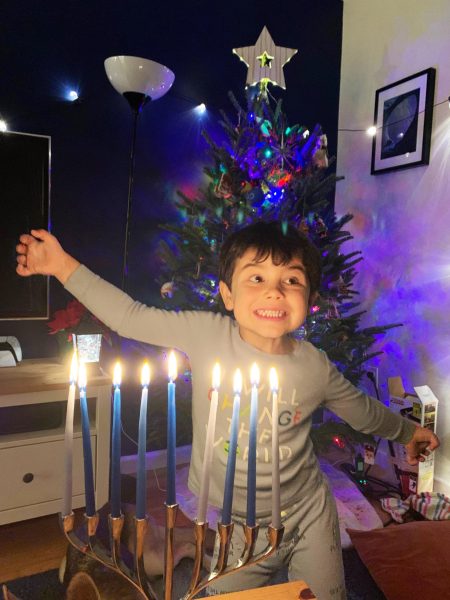
With the many traditions a few stand out greatly, the biggest one and one of the most recognizable symbols of the holiday is the lighting of the menorah. The menorah is a candelabra with seven spots that symbolize: divine wisdom, the seven days of creation, the center candle representing the Sabbath, the burning bush, and the presence of God.
“My family uses a special menorah that a family member who passed away created,” junior Anna Solomon said. “It is a nice way to remember and celebrate her life while also enjoying the candle lighting and being with family.”
The tradition has someone light a candle nightly until the sabbath which is observed from Friday at sunset to Saturday at nightfall.
Another tradition that came to the holiday down the line is a children’s game named dreidel. Dreidel played with a four sided top on which four Hebrew letters are written. These traditions bring together all sorts of people to enjoy the holiday.
“I don’t really believe in anything but traditions can be really important for family togetherness and memories, especially in the face of a lot of antisemitism,” Paz Soldan said.
Kwanzaa
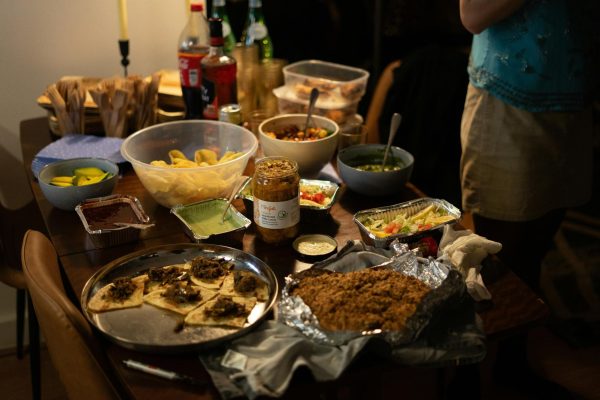
Kwanzaa is a winter holiday primarily celebrated by African American families in the United States as well as Canada and the Caribbean. The holiday is celebrated from Dec. 26th through Jan. 1st.
The name as well as the celebration were created in 1966 by a man named Maulana Karenga. Karenga borrowed the word Kwanzaa, meaning “first” from the Swahili phrase “matunda ya kwanza,” adding the seventh letter, an extra a, to make the word long enough to match one letter for each of the seven children present at an early celebration of the holiday.
For many, Kwanzaa is not a religious holiday but a cultural one. The holiday is simply celebrated by many as a respectful time to be thankful for what people have accomplished and what peoples ancestors have accomplished.
“A lot of the values of Kwanzaa are things like gratitude, and things like community as well as giving, and doing some introspection that coincides with Christmas,” student support coordinator Christopher Edmonds said. In its early years, Kwanzaa was celebrated primarily within African American community groups but by the late 1970s and early 1980s, the holiday began spreading into homes, schools, and churches. After that event its visibility grew further in the 1990s as mainstream media, retailers, and schools started to acknowledge the holiday. However the holiday, despite being popular, can easily be celebrated with other winter holidays based on religions.
“What’s great about Kwanzaa is that you can celebrate Kwanzaa and Christmas as well,” Edmonds said.
Today, Kwanzaa is observed by millions in the United States. While its traditions continue to evolve, the history of Kwanzaa remains tied to its original purpose which was celebrating African heritage, promoting unity among all, and encouraging a sense of cultural pride.
“I love the values behind Kwanzaa, like gathering together to uplift one another, and I think that it truly represents the African diaspora as a whole in regards to the diversity in cultures, shared unity, and sense of understanding,” senior and Black Student Union (BSU) Co-President Hosana Ghirmay said.
In the end what began as a response to a moment of great change in society has become a lasting yearly reflection on people’s communities, their identities, and shared values among all who celebrate the holiday.
“This holiday connects to our school because learning about Kwanzaa helps promote cultural awareness and respect for different histories,” senior and BSU Co-President Sabrin Adem said.