

The Middle East is once again at the forefront of escalating political tension, confronting regional conflict and humanitarian crises all at once.
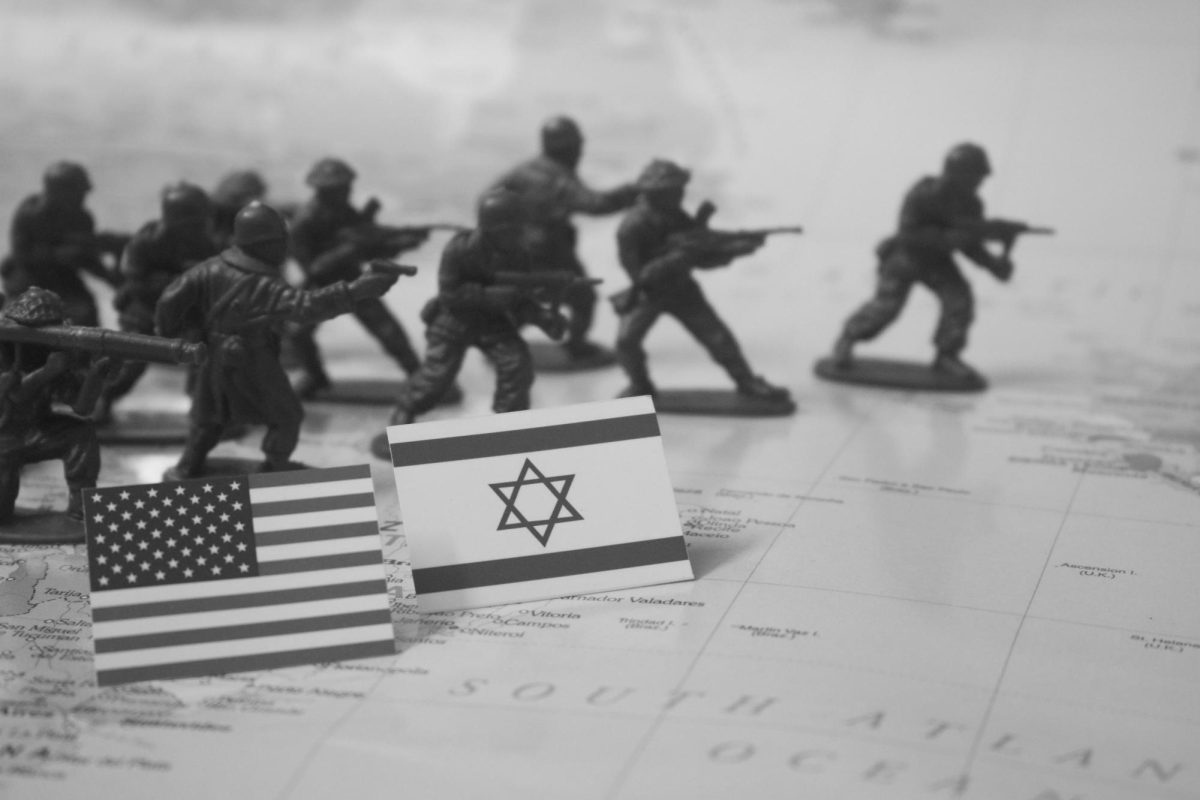
On Feb. 28, the United States and Israel established a coalition and launched a joint-invasion of Iran, launching coordinated strikes on Iranian cities and infrastructure. They aim to depose the Iranian government, replace it with one that reflects the political interests of the U.S. and Israel, eliminate Iran’s regional allies, and attack the nation’s energy research facilities under the propagated presumption that its government is developing a nuclear weapon.
President Trump made a post on Truth Social — a far-right Twitter clone that effectively acts as a megaphone for Trump’s statements regarding US military and political decisions abroad — vowing that “a whole civilization will die tonight, never to be brought back again.” He was referring to the US’ launching of hundreds of missiles on Iranian strategic targets, both civilian and military-based.
Colossal statements and provocative political decisions adjacent to Trump’s post are only a smaller part of a larger plan by the Trump administration to promote an “America First” foreign policy: one that utilizes the US’ military power to occupy and weaken nations that can potentially undermine US economic control around the world.
The impact of the war on Iranian civilians is catastrophic. So far, U.S. and Israeli precision strikes have destroyed over 80,000 civilian buildings — including homes, hospitals, and schools — and have slaughtered over 1700 civilians, 260 of them being children… all in the span of a month. Numerous protests have broken out throughout Iran protesting the invasion and its impact on the livelihoods of millions of Iranian families.
The relentless assault on civilian life did not stop at Iran. Tel Aviv’s strikes caused an unparalleled civilian loss of life in Lebanon, Israel’s next target in reinforcing its stranglehold of the region. Over 1,300 Lebanese civilians lost their lives, many of them being children, health workers, and journalists.
Israel’s target in Lebanon, Hezbollah—a pro-Iranian military organization known for its support to indigenous Palestinian resistance groups—is still at-large, delivering dozens of strikes to Israeli military outposts daily.
Israel’s “retaliatory” strikes were claimed by its government to be targeted purely at militant infrastructure. However, junior Adam Akkouche offers his family’s personal narrative regarding the reality of the Israeli government’s claim. Citing the destruction of his family’s local business, a store that was supplying the town with water for the last few decades, by a targeted Israeli missile strike, he suggested that the intense military action of the Israeli Defense Forces (IDF) may not have been limited to military targets.
In spite of their losses, the Iranian government continues to hold out against the coalition’s bombardments, with Iranian missile strikes destroying several sites of strategic importance to the coalition. A key site of intense combat is the Strait of Hormuz, a maritime gateway between the coast of the gulf states—Bahrain, Kuwait, Oman, Qatar, Saudi Arabia, and the United Arab Emirates (UAE)—and the Indian Ocean.
Most of the gulf states’ economies are heavily dependent on selling their natural resources, specifically their abundant oil reserves, to the U.S.
The closing of the Strait of Hormuz could pose disastrous economic consequences for a number of the Gulf states’ nations and potentially undermine Washington and Tel Aviv’s supply of oil, disabling their ability to fuel their war. If Iran continues to pummel U.S. and Israeli military infrastructure in the region, it will disable U.S. and Israeli ability to mount a ground invasion of Iran in the future, transforming the war from a single, decisive battle into a long-term, uncertain war of attrition.
Iran reached out to China and Russia for military and industrial support. The two global powers provided AI-enhanced and high-resolution satellite imagery to the Iranian military, breaking U.S. control over military intelligence in the region.
The regional consequences of the conflict, both for the coalition’s geopolitical power and its claimed adherence to international legislation, have sparked outrage by representative groups, both domestic and abroad. The United Nations Human Rights Council denounced the coalition’s war against Iran as “flagrant violations of international law,” with the Trump administration’s domestic political support rapidly waning as its “America first” policy continues to meet unprecedented military resistance in Iran.
Students from varied schools were asked how they felt about the ongoing conflict; some provided further insight.
Yalda Bulorchi is an Iranian student from Langley High School (LHS).Her family is among the nation’s diaspora—former inhabitants displaced by political or social conflicts. She provides personal, first-hand insight into the nature of the conflict and the existential intentions of the coalition: “An invasion will completely destabilize the nation, which is what Israel and the U.S. want… it will hijack the people’s right to self-determination and deny the Iranian people of their dignity,” Bulorchi said.
When asked about the impact of the war on her extended relatives, who are still living in Iran, she recounts: “My family in Iran are very frightened… they don’t go out into the open because they are afraid of being bombed… Every time I open the news, I feel my heart sting.”
In light of Iranian protests against the nation’s leadership in the months following up to the war, particularly those focused on the material and social conditions of working Iranians, she expresses her frustration with the regime but also warns of western interventionism’s historically-recurring consequences, refuting the notion that military escalation is a necessary tool to advance reform and revolution. She declares:
“So many countries outside of the west continue to face the long term repercussions of intervention… Iran is not a pawn and the west does not have a claim to Iran. Iran should defend itself from western occupation so that its revolution comes from the people, not foreign governments.”
Shiloh, a sophomore at AHS who wishes to be referred to by her first name for privacy reasons, is an avid reader of historical geopolitics. She explains the nature of the conflict from a geographical and economic standpoint, observing that “this war is part of a pattern of imperialist aggression from the United States.” She maintains that “the U.S. and Israel see Iran as the last force that opposes their strategic dominance in the region” and when the two nations “use unsubstantiated excuses like ‘nuclear disarmament’ or ‘liberation,’ it allows [the U.S. and Israel] to excuse their expansionist motives and consolidate their control over Iranian resources, strengthening their individual economies.”
Steve Perez Calero, a junior at AHS, reflects: “It’s really heartbreaking how many people are caught up in this conflict. Many innocent people have been badly affected by this situation…” He argues that, “There has to be a diplomatic solution that could be made with both sides to stop all this destruction,” before concluding, “It’s also important to speak up about it to try and make a difference, even if it’s simply just talking about it, every little action counts.”
Although a ceasefire arrangement was reached between the two sides on April 7, the coalition continues to attack civilian and military targets in Iran and Lebanon, further eroding any potential for diplomatic reconciliation between the U.S./Israel and Iran in the future.
Such complications, compounded with international legislators speculating the legality of Washington’s and Tel Aviv’s objectives in the region, the White House scrambling to justify the ongoing casualties to its own political bodies of support, and the economic consequences of maritime combat in strategic chokeholds to the coalition’s allies, the war that Israel and U.S. embarked upon is not only turning out to be a longer campaign than the coalition expected, but is also dealing a heavy blow to the reputation of the U.S. and Israeli government.