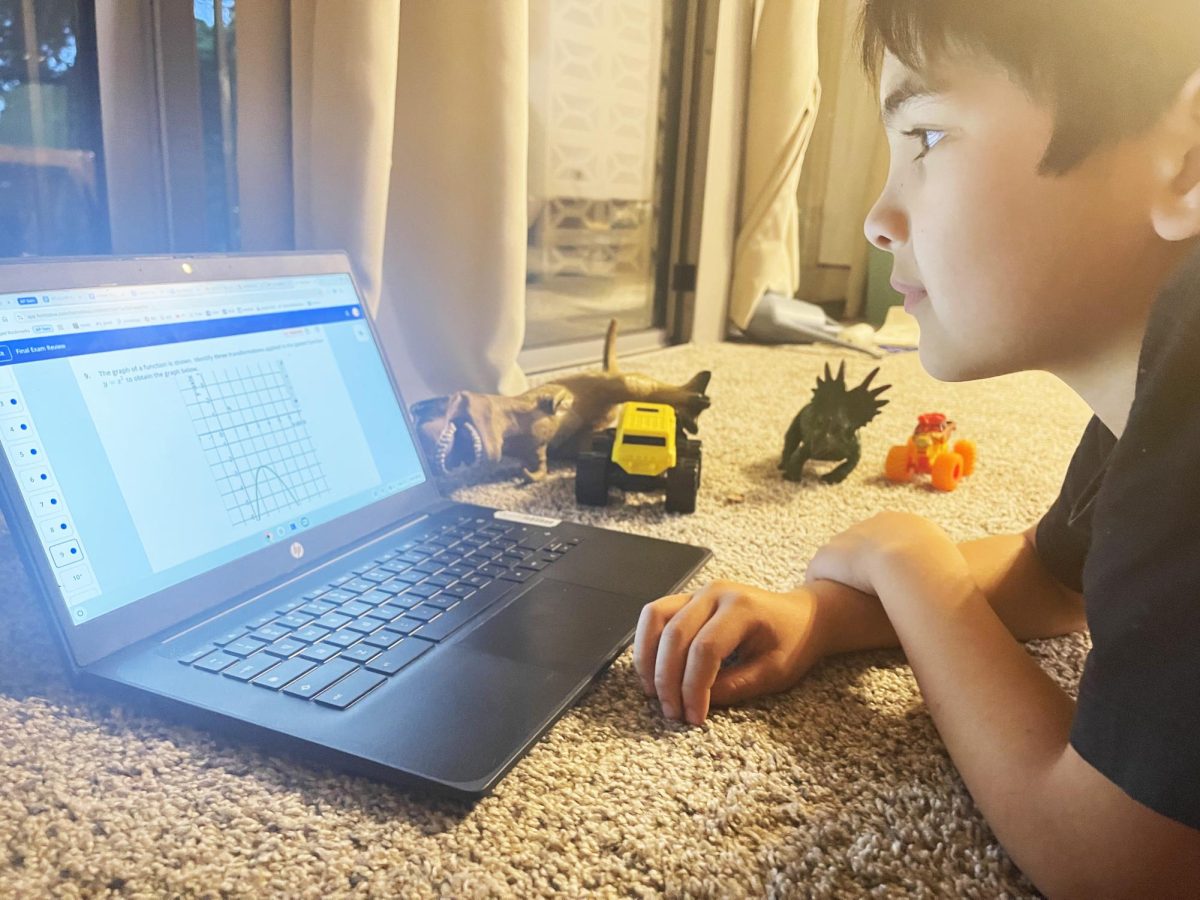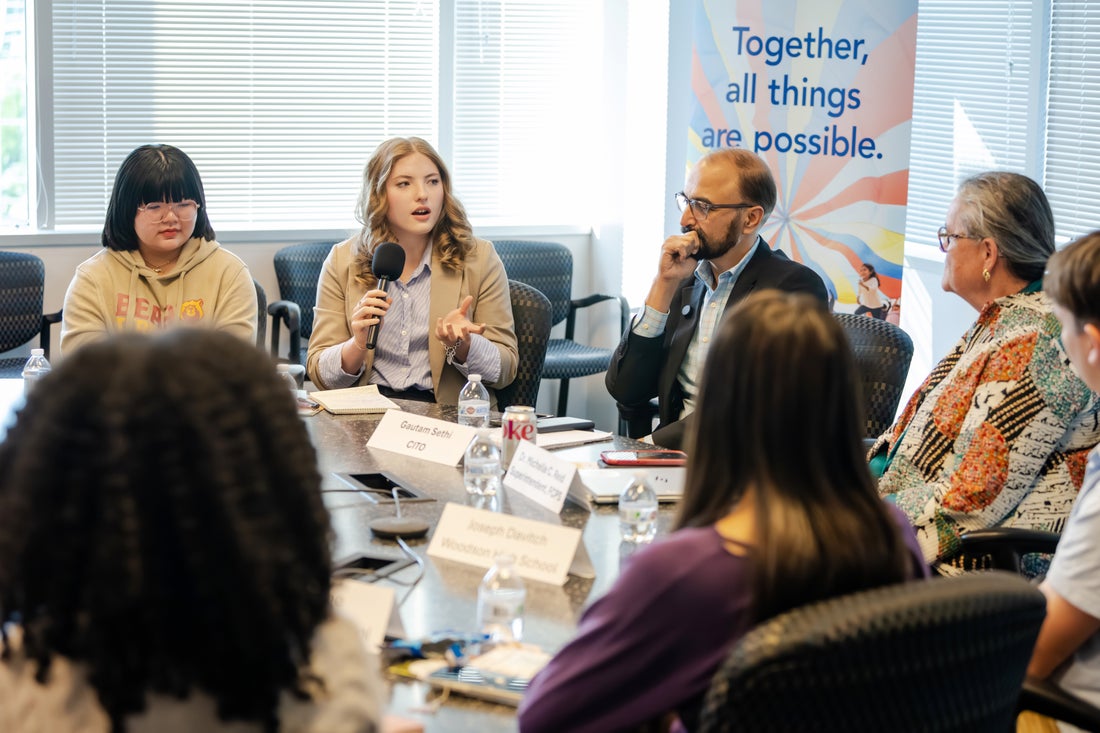



Your homework shortcut is about to become your teacher’s new assistant: a new county-wide partnership with OpenAI will soon change the learning environment across all of Fairfax County Public Schools. FCPS Superintendent Dr. Michelle Reid announced in an email on Nov. 19 that the division will be one of the first to test “ChatGPT for Teachers,” helping shape how the tool will be used in schools nationally.
Currently, there has been no formal development or training in place as the county has yet to share its rollout plan.
“We’ve been following county policy. I didn’t want to get too ahead [and do] something that the division wasn’t,” Principal Shawn DeRose said. “There’s a handbook for staff around it, but when it comes down to the staff getting their hands on it and doing professional development, we haven’t done that yet.”
With the implementation of artificial intelligence in classrooms, reactions among staff are bound to vary, and its success will depend on how well its purpose and expectations are explained.
“It’s gonna be like anything that’s relatively new. You have staff who are going to be early adapters, staff members who [will] just go with the flow and then you’re gonna have staff who [won’t] necessarily embrace it,” DeRose said.
The idea of using AI is not completely unfamiliar to teachers. In language classes, several already use it informally to assist their lesson planning and create practice materials, especially when existing course materials fall short for student needs.
“In the past, I would have had to write 19 texts because I wanted every kid to have a different problem. Now, I just [say] ‘I want 19 texts that follow this structure,’ because what I’m gonna teach is text structure. That’s what I care most about,” Spanish teacher Sandra Caldere Mejias said. “[AI] can do it for me, which saves me a lot of time. I have more time to plan and have meetings with my students.”
The district rollout will allow teachers to access a safer, more education-aligned rendition of ChatGPT, as there will be privacy and security safeguards in place, according to Rachel Ligairi, a mother of two AHS students who is a senior product manager at a software company.
“Teachers can feel safe in uploading their lesson plans and information about their classes, what kind of preparation their students have or things like that,” Ligairi said. “And they can have specific GPTs that learn about their needs and their preferences over time.”
While indeed a timesaver, AI is far from a perfect solution. Caldere still reviews and changes whatever it produces as needed, something she does even with real workbooks. She said that it is “a tool, but not the answer.” Neither teachers nor students should become overly reliant on AI.
“I understand that teachers have a huge workload, and that it’s very taxing on them, but at the same time, I feel like giving everyone an AI account and letting them put in the same prompts is gonna output the same lesson over and over again,” junior Nattha Poolchuay said. “That really takes away from the creativity of teaching and the point of their job. The point is to connect with the students.”
Poolchuay notes that AI should only be used for “menial things,” like replying to emails to streamline work—not actually be used in learning.
“I’m really concerned about the way [things] would be graded because they already have the WorkKeys, and those are graded by AI. But the way the AI grades, it doesn’t grade like a teacher, it doesn’t know the nuances of what you’re saying,” Poolchuay said. “It doesn’t actually understand anything. So it doesn’t feel fair when you get [a bad] grade, you’re being cheated out of an actual person judging your work.”
However, it is not certain if AI will be used to grade work. FCPS shared that ChatGPT for Teachers will “provide support, planning, communication, translation, and data analysis at no cost to schools until June 2027.”
“The way brains process isn’t exactly linear. Everything’s not gonna be the same; something might work for you, but it might not work for someone else,” junior Molly Corcoran said. “[A computer] can’t make those connections. AI can’t understand individual students, which makes it hard for the communication factor.”
As there remains no announcement about how AI will be integrated into teaching, there are still many questions about how to properly use it, and if it will work as intended.
“It can be abused and misused, but fundamentally what I’ve found in talking to academics and students about this is, most students and faculty, they want to do a good job,” Ligairi said. “They want to learn, they want to teach, they want to be engaged, and most of them are really looking for ways to use these tools in service of those goals.”