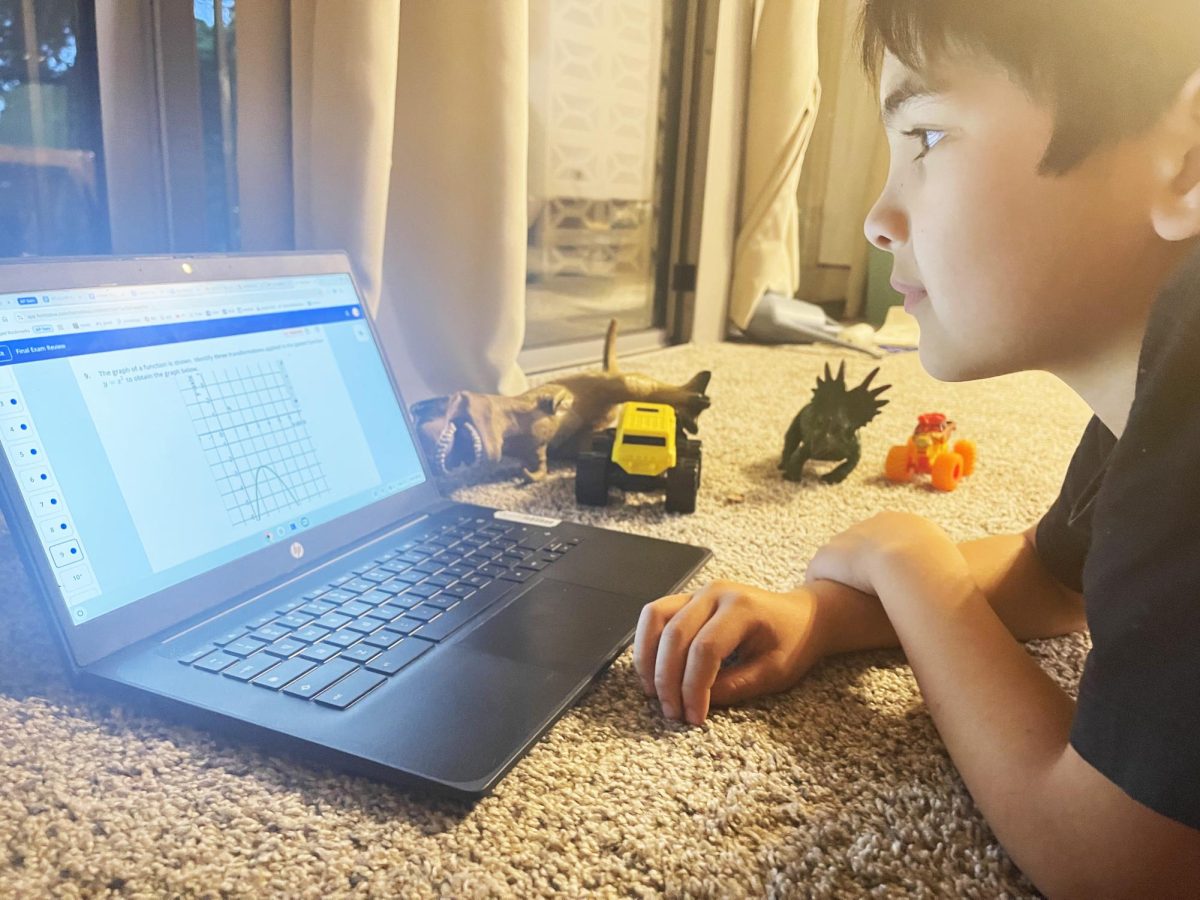


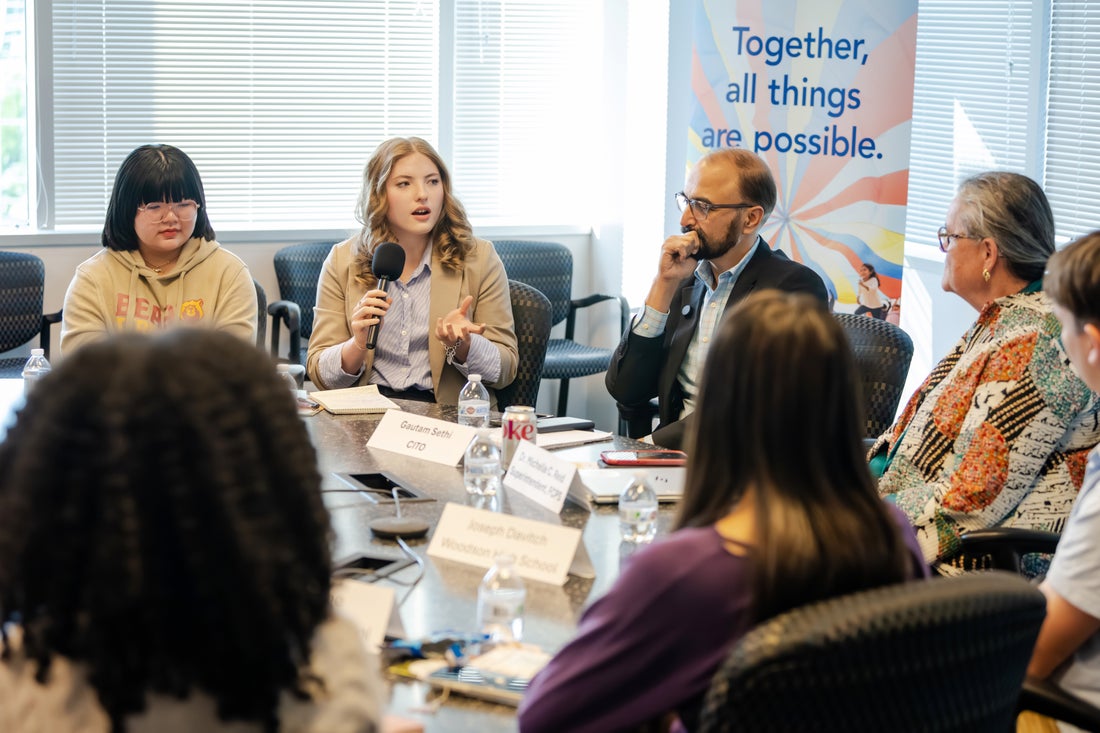
Right now, society can’t seem to agree whether AI should have a seat in the classroom; however, FCPS has a clear directive of attacking this “Sputnik moment”-as Superintendent Dr. Michelle Reid calls it–by exploring and adapting to AI’s rapid development.
To integrate AI into classrooms, FCPS has partnered with OpenAI’s “ChatGPT for Teachers” pilot program, and announced guidelines that promise to take an adaptive, human-centered approach while accounting for ethical and safety concerns. An AI policy is set to be voted on and adopted by the FCPS School Board by the end of the school year.
“I had someone recently say it’s a lot like electricity. We cannot not talk about it or learn about it, it’s here,” Dr. Reid said during the second-annual student journalist roundtable last month on the topic of education and AI.
While these guidelines state that FCPS will not take AI-use lightly, opinions remain polarized in the educational sphere. Some AI adopters argue that AI should be used as a tool to help teachers and students by maximizing efficiency; personalizing learning experiences, especially for students with learning disabilities and language barriers; and creating more opportunities for educators to connect with students.
AHS marketing teacher Dayton Henceroth mentions how teachers can upload content requirements to receive detailed rubrics, assignments, and quizzes, freeing up personal time, while serving as an opportunity for students to see AI’s variety of functions and effectiveness when given specific prompts.
However, others argue that students could become overly dependent on AI, deteriorating their cognitive skills and increasing cheating. There are also those who are most concerned with the environmental impact of AI data centers, and are worried over the lack of user safeguards.
“I think that [integration of AI into education] is going to distract people from learning,” AHS technology specialist Thomas Hill said. “I think that they’re going to have emotional attachments to [AI] that are going to draw them away from their own creativity.”
Sixty-five AHS students shared their perspectives and AI-use habits in an anonymous survey, revealing students are more skeptical about educational AI use than many adults may suspect.
The majority of students agreed that AI educational use should be human-centered and that the leading focus should be the consequences of using it. Additionally, nearly half reported using AI on assignments but not relying on it, with only two students reporting that AI does their work for them. Others mostly use AI to better understand concepts and create study resources.
When student journalists asked about challenges, limitations and concerns with AI classroom use, Reid acknowledged them, but overall emphasized the benefit of its integration as a tool.
“Each of you has creativity, a personal view on things, you should never give that up to someone else or something else,” Dr. Reid said. “That is what makes you uniquely you. [These tools are] not to replace your thinking and not to replace your ability to problem solve or critically think.”
While Henceroth’s and Hill’s perspectives differ on educational AI use, both agree AI should function as a tool rather than being a crutch.
“We’re the architect. We’re the creator. We always have to put ourselves as the responsible party in that loop of using AI,” Henceroth said. “My whole attitude has been very open to embracing [AI use] because it’s a tool just like anything else.”
Henceroth exemplifies this attitude, having AI help him create lesson plans and assignments. He emphasizes the time it saves and it is an opportunity to teach students to use AI not only for academic gains, but also to ensure their job security later on as AI is becoming a fundamental workforce skill.
Hill echoes the sentiment that AI will not single-handedly transform education: “[AI is] only a tool and if it was going to revolutionize anything, it would’ve done so already,” he said. “If it was [going to] revolutionize medicine and cure cancer and all these other diseases, it would’ve already done that.”
Currently, FCPS technology specialists are being trained, while most teacher training will begin next school year. Nevertheless, all FCPS staff members must comply with the AI user agreement policy, which will continue to evolve.
In the classroom, though, students can expect student AI use agreements, age-appropriate lessons on AI literacy and academic use cases , elective AI courses, and non-generative chat FCPS-monitored AI tools becoming available, among other possibilities. And while these additions could help to demystify AI use, FCPS maintains that students are “not required to use AI tools.”
“I think that it’s important that we think about how to best support our students learning to use tools responsibly, and to use the tools to improve their human skills,” Reid said.